


In the pharmaceutical industry, improving development speed without compromising accuracy is a constant challenge — especially for complex systems such as ointment bases.
At Indovinya, we are addressing this challenge by using machine learning to support the development of polyethylene glycol (PEG)-based formulations.
Traditionally, defining the best combination of excipients requires extensive trial-and-error in the laboratory — a process that is time-consuming and resource-intensive.
With data-driven models trained on experimental results, it is now possible to predict how a formulation will behave before running lab tests.
What does this mean in practice?
Using data from rheological and textural analyses, we developed models capable of predicting key formulation properties, including:
- Spreadability
- Consistency and extrusion behavior
- Elastic rigidity (G’)
- Yield point and cohesiveness
The results showed strong agreement between predicted and experimental values, confirming that the models accurately represent formulation behavior.
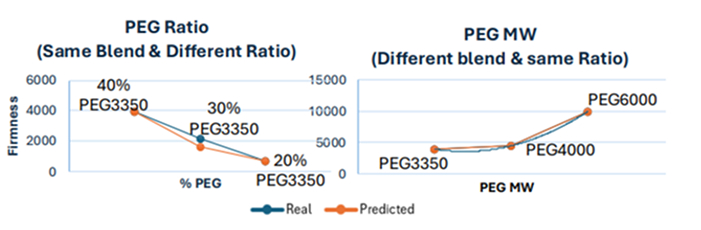
As shown above, predicted values closely follow real data trends, reinforcing the reliability of the approach.
Key insights from the study:
One of the main findings was that:
The ratio between PEGs has a greater impact on formulation properties than their molecular weight alone (within the tested range).
This insight helps guide formulation decisions with more confidence and reduces reliance on trial-and-error.
Impact on formulation development:
By using predictive models, formulation development becomes:
- Faster, with fewer experimental iterations
- More cost-efficient, by reducing lab work
- More accurate, supporting better early-stage decisions
- More flexible, allowing multiple scenarios to be explored
It also becomes possible to evaluate different formulation options before committing to lab-scale testing.
Predictive simulation in practice:
The model can also simulate the performance of PEG grades that were not experimentally tested.
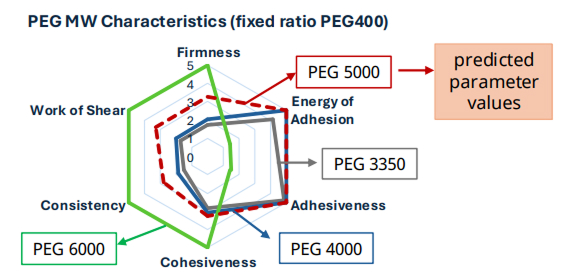
In this example, the predicted behavior of PEG 5000 is compared with experimental data from PEG 3350, PEG 4000, and PEG 6000.
The chart shows key parameters such as firmness, adhesiveness, cohesiveness, consistency, and work of shear in a single view.
This demonstrates that predictive models can:
- Reproduce known behaviors
- Anticipate the performance of new materials
In practical terms, this helps formulation scientists evaluate options, prioritize the most promising solutions, and reduce uncertainty before testing.
Our commitment
At Indovinya, we combine advanced data science capabilities with deep application expertise to deliver innovative, reliable, and scalable solutions. Learn more about our pharmaceutical solutions. Connect with our experts or visit: Excipients